The bride is beautiful but she is already married
See also https://brideisbeautiful.hcommons.org/
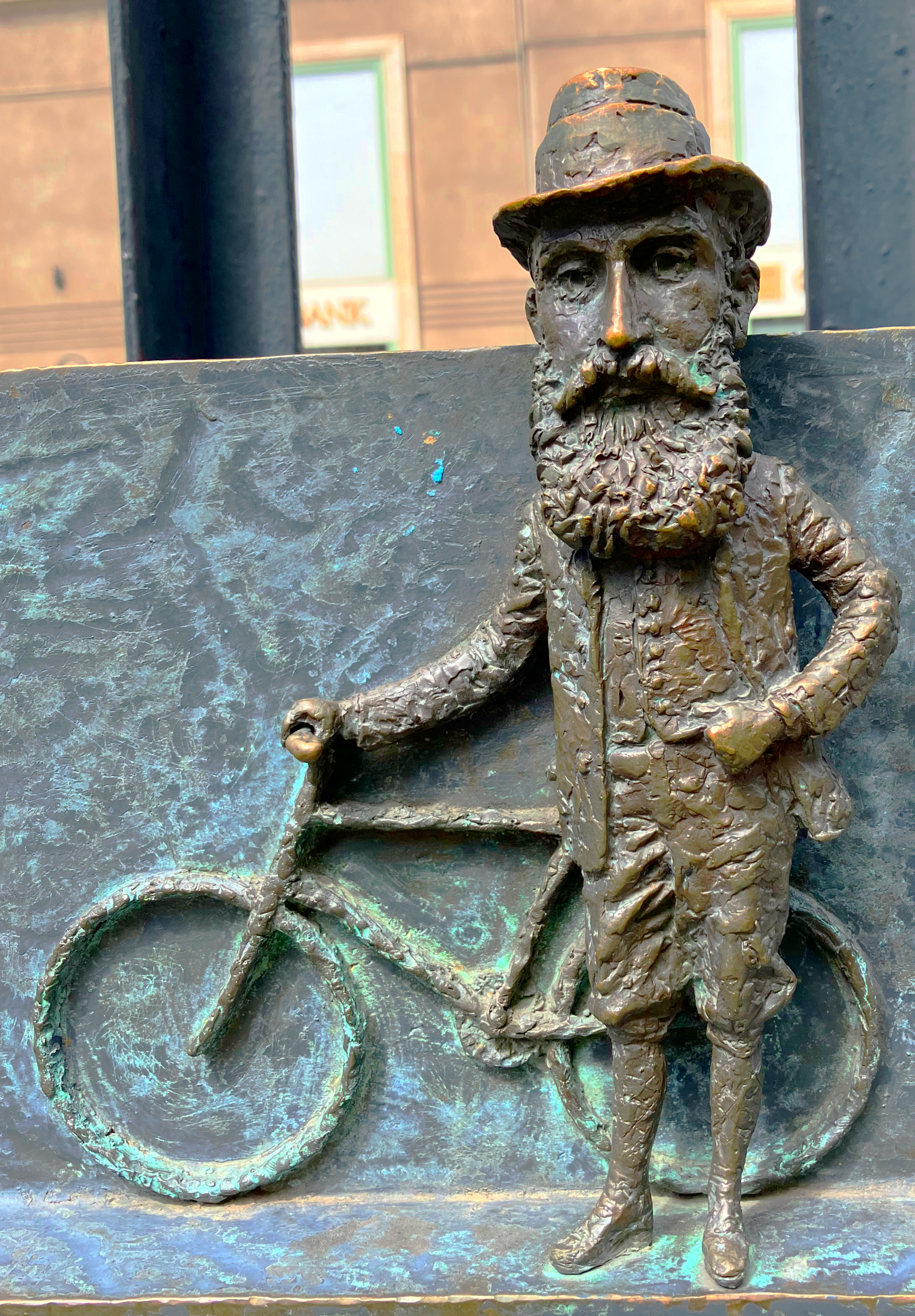
Mihály Kolodko's miniature Herzl in Budapest, Hungary. Photo — Shai Afsai
All versions of “the bride is beautiful but she is already married” stories — which are often set during the 1890s (in Ottoman-ruled Palestine) and less frequently during the 1920s (in British Mandatory Palestine) — lack primary sources.
An early example of the myth appears in an article by Eric Silver, The Guardian’s foreign correspondent and expert on Israel and the Middle East, written on the ten-year anniversary of the Six-Day War, in 1977: “An ageing pioneer was interviewed once on Israeli television. He explained how the elders of his Russian Jewish village had sent an emissary to Palestine to spy out the land. The man reported back: ‘The bride is beautiful, but she is already married.’” In other versions of the stories it is the rabbis of Vienna who dispatch rabbinic representatives on a fact-finding mission to the Land of Israel/Palestine and receive their reply. In yet other versions, the rabbis are sent by the First Zionist Congress, or Theodor Herzl himself, or his friend and fellow Zionist leader Max Nordau.
Sometimes the same writer will alternate between the stories’ different versions. Perhaps such changes are inevitable, as in all their variations the core of the stories do not have a historical event to reference, and their tellers have been less concerned with accuracy than with advancing political and ideological agendas. This much has remained constant: while no primary sources for the stories have surfaced, they continue to be retold uncritically — and by now often with full awareness, on the part of those who tell them, that the stories are baseless. The anti-Zionist potential inherent in the “bride is beautiful” stories remains irresistible to many scholars, journalists, and filmmakers.
“The bride is beautiful” stories analyzed
Atlanta Jewish Connector, February 4, 2025
The ubiquity of “The bride is beautiful, but she is married to another man” stories presents a troubling example of how scholars, journalists, and filmmakers regularly dispense with accuracy and evidentiary standards when dealing with Jewish, Zionist, and Israeli history.
(This article is a follow-up to 2020’s “The bride is beautiful, but she is married to another man.” The tenacity of an anti-Zionist fable.)
“The bride is beautiful, but she is married to another man.” The tenacity of an anti-Zionist fable
Fathom Journal, Autumn/December 2020
Some authors are unwilling to dispense with unsubstantiated stories, opting instead to put scholarly standards aside in their attempts to advance anti-Zionist arguments. One case in point is the “married to another man” fable.
(This article is a follow-up to 2012’s “The bride is beautiful, but she is married to another man”: Historical Fabrication and an Anti-Zionist Myth.)
Shofar: An Interdisciplinary Journal of Jewish Studies 30:3 (Spring 2012), pp. 35–61
According to a frequently repeated story, during the early years of the Zionist movement a number of European Jews were sent to Palestine to investigate its suitability as a location for a Jewish state. They reported back, the story concludes, that “the bride is beautiful, but she is married to another man“ — Palestine is an excellent land, but it belongs to others.
While its details vary with the telling, the story’s central point is often the same: already in the early years of the Zionist movement, Jews recognized that it would be unjust and immoral for them to try to claim Palestine; despite this awareness, the Zionists proceeded with their plans for Jewish statehood there; from the outset, therefore, the establishment of the state of Israel was an act of severe and willful injustice.